


hECM’s sol-gel mixture exhibits temperature-controlled gelation properties, making it an ideal choice for a broad spectrum of research applications. Whether your work involves 2D and 3D culture systems or in vivo tumor engraftment studies, hECM integrates seamlessly into your workflows.
In addition to providing the scaffold itself, Preci offers a comprehensive package of support and information. This includes guidance on optimizing your experiments, protein quantification, mechanoelastic property analysis, and detailed structural analysis of the formed gels. With hECM, you can enhance your research outcomes with confidence, knowing that you are using the most advanced ECM product available.
AFM-based feature extraction
Atomic Force Microscopy (AFM) is a powerful tool in ECM profiling, offering unparalleled insights into the physical properties and nanoscale structures of the extracellular matrix. By measuring features such as surface topography and elastic modulus under various conditions, AFM enables researchers to precisely characterize the mechanical landscape cells experience. These detailed measurements are critical for creating realistic tissue models and enhancing our understanding of cellular responses to mechanical cues, a vital factor in tissue engineering, proteomic studies, and signaling research. AFM-based ECM profiling thus provides a foundation for developing tailored biomaterials and fine-tuning cellular interactions in regenerative medicine and beyond.

Proteomic profiling
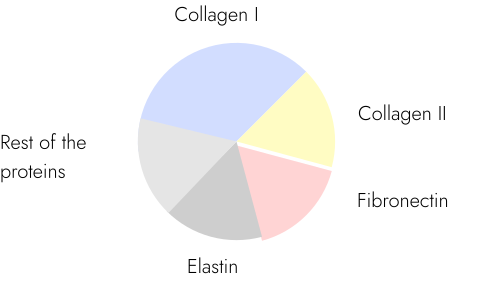
Proteomic profiling of the extracellular matrix (ECM) is essential for understanding the molecular composition and functional dynamics within cellular environments. By identifying and quantifying the diverse proteins within the ECM, researchers gain insights into how protein interactions influence cellular processes such as adhesion, migration, and differentiation. This information is crucial for designing biomimetic materials in tissue engineering, uncovering biomarkers in proteomic research, and elucidating pathways in signaling studies. Proteomic profiling enables the creation of more accurate tissue models, supporting innovations in drug discovery, regenerative medicine, and personalized therapies.
Mechanical properties

Profiling the mechanical properties of the extracellular matrix (ECM), such as elasticity, stiffness, and viscoelasticity, is essential in understanding how cells perceive and respond to their physical environment. These properties influence cellular behavior, including adhesion, proliferation, differentiation, and migration, making them crucial parameters in tissue modeling and engineering. By measuring mechanical aspects of the ECM under various conditions, researchers can create more accurate in vitro models that mimic native tissue environments. This understanding enables the development of tailored biomaterials and optimized cell culture systems, paving the way for breakthroughs in regenerative medicine, proteomics, and signaling research.